

Why My Knights Are “Old”
by Claire Ashgrove
If you’ve been following the blog tour, yesterday you read an interview with Merrick du Loire, the hero in IMMORTAL HOPE, and you probably recognized his speech is a little antiquated. He’s definitely not a modern man. And, on some levels, Anne initially exchanges “chivalrous” for “chauvinist.”
When I developed the series, I put a lot of thought into how I wanted to portray the knights. Eventually one thought refused to leave my head – “These men have been around for centuries, but all the life lessons of importance they learned in the 12th Century.”
If you consider the values we learn in our first twenty years of life, for most of us, that builds the foundation for adulthood. That’s often why we “turn into our parents”. I had a difficult time believing that even though they were adults for centuries that time could erase core values and beliefs.
Secondly, it’s only been the last 100 years where we, as a society, have moved away from the traditions or principles of our ancestors. Prior to 1900 the role of men and women was very cut and dry. A few exceptions occurred, but as a rule, men had their responsibilities and women theirs. We were also a very warlike society – and some would argue we still are, but I counter that we’re nowhere as warlike as Europe prior to 1700.
If you consider a man born in roughly 1100 has lived 900 years. Only the last century have values begun to shift into what we call “modern society”. I find it incredibly difficult to believe that 800 years of different principles can just be erased because the rest of society shifted.
Last, I spoke with someone who’s an immigrant and came overseas as a child. He has no accent to his speech, despite hailing from a country where we would consider the accent thick. His sister, who’s only a few years older than he, however, has a very thick accent. Evidently, there’s a point in life where the way we learn to speak stays with us, despite how long we speak a second language. That’s why accents carry over and only truly disappear in those who put conscious effort into altering speech.
All of that combined into a firm opinion on how knights who’ve been alive for 900 years, give or take, should appear in the series – they must be antiquated. They can’t just embrace the idea of women’s liberties, they can’t just stand aside and compromise ingrained values. They can’t suddenly become metro-sexual men in tune with their feminine sides either.
They must, at all costs, embody the complete picture of a knight.
And that’s why my knights are old, not just in age, but in spirit and thought as well. I’m curious though – what are your thoughts? Would you concur that 800 years of life would stamp certain things into an individual? Or would you make the argument that centuries-old people would change as society changes, and adapt to the standards of today?
~Claire

Claire lives on a small farm in Missouri with her two toddler sons, fifteen horses, four cats, and five dogs. In her “free” time, she enjoys cooking, winning at rummy, studying ancient civilizations, and spending quiet moments with her family, including the critters. She credits her success to her family's constant support and endless patience.
To learn more about Claire, visit her at:
www.claireashgrove.com
www.toristclaire.com
TWITTER: @ClaireAshgrove
Giveaway Time!
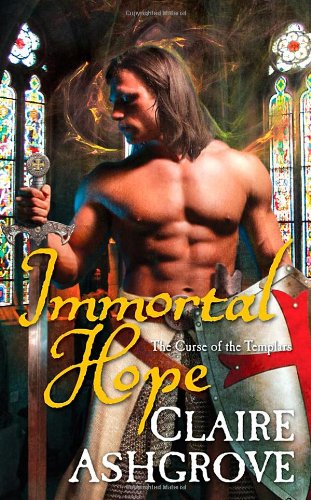
Centuries ago, Templar knights defied the archangels and unearthed the copper scroll that revealed the locations of the gates to hell. Cursed for their forbidden act, they now roam the earth, protecting mankind from evil. But darkness stalks them, and battles they fight bring them ever closer to eternal damnation. One promise remains to give them salvation—the return of the seraphs.
Embittered by his purpose, Merrick du Loire must honor an ancient pact and bring peace to his cousin’s soul, releasing him from the clutches of their enemy. When he stumbles upon history professor Anne MacPherson, he discovers that she possesses a sacred artifact that marks her as a seraph. Duty demands he set aside his personal quest and locate the knight she’s fated to heal. As Merrick struggles with conflicting oaths, Anne arouses buried hope and sparks forbidden desire that challenges everything he’s sworn to uphold.
Anne has six weeks to complete her thesis on the Knights Templar. When Merrick takes her to the Templar stronghold, he presents her with all she needs—and awakens a soul-deep ache that he alone can soothe. Yet loving Merrick comes with a price. If she admits she is destined for him, her gift of foresight predicts his death.


